

Showing posts with label Literacy. Show all posts
Showing posts with label Literacy. Show all posts
Sunday, January 26, 2014
Reading Street Trifold Templates
My days as an Instructional Specialist are busy conducting data meetings, analyzing data, reporting out the data, and participating in lots of professional development. I recently had a request inquiring about the Reading Street trifolds. After doing a little searching, I came across a blank template from proteacher.net. Click {here} if you are interesting in downloading the template. As Reading Street publishes new versions of their Reading series, the page numbers often change. Hopefully this template will help those of you with a different version than my district. Happy Teaching!

Monday, February 18, 2013
Nancy Fetzer Literacy Connections
Back in December I took part in a three day training on Nancy Fetzer Literacy Connections. We were very lucky to have Nancy Fetzer herself as our trainer. My district had adopted her writing program many years back and implemented lots of training then. Now that we have moved to Common Core, my district decided to revisit Nancy Fetzer Writing since it ties in perfectly with meeting Common Core skills in ELA. If you have never heard of Nancy and the strategies she uses, I highly recommend her! She is currently in the process of getting all of her video demonstrations and her materials onto her website. She also has a ton of videos on YouTube that are linked from her website.

In the last few weeks I began training the staff at my school to use Nancy Fetzer Movie Scripts, Word Masters, and Story Blasters. I started off by having staff look at the Three Tiers of Vocabulary from the Common Core Appendix A. Once everyone had a better understanding of the Three Tiers of Vocabulary, I had each team begin looking at choosing 3-4 Tier II Vocabulary words for Kinder - 1st grade and 5-7 Tier II Vocabulary words for 2nd - 5th grades that teams would be using in the next few weeks for their Focus Story.
Once teams had their words decided upon, they would then create a Story Blaster using the vocabulary words that students needed to know for their upcoming story. Students will practice reading the Story Blaster numerous times. The teacher will divide the class into two groups – readers and definers. Readers will read the story blaster and stop when they read a vocabulary word. They will point to the definers. Definers will repeat the word, provide the definition, and act out TPR. Here is a sample from the 3rd grade training.


In the last few weeks I began training the staff at my school to use Nancy Fetzer Movie Scripts, Word Masters, and Story Blasters. I started off by having staff look at the Three Tiers of Vocabulary from the Common Core Appendix A. Once everyone had a better understanding of the Three Tiers of Vocabulary, I had each team begin looking at choosing 3-4 Tier II Vocabulary words for Kinder - 1st grade and 5-7 Tier II Vocabulary words for 2nd - 5th grades that teams would be using in the next few weeks for their Focus Story.
Once teams had their words decided upon, they would then create a Story Blaster using the vocabulary words that students needed to know for their upcoming story. Students will practice reading the Story Blaster numerous times. The teacher will divide the class into two groups – readers and definers. Readers will read the story blaster and stop when they read a vocabulary word. They will point to the definers. Definers will repeat the word, provide the definition, and act out TPR. Here is a sample from the 3rd grade training.
It started on a sunny winter day at my
house. I was for once ecstatic about taking my math facts test at school,
because I had studied the night before. I knew if I passed my test I would get
to go to a movie that weekend. As I got
ready for school that morning, I kept repeating my math facts to myself. My
older brother started to mock me which really made me mad. My mother hurried
me into our car which she had let idle to warm
up the engine. The car started out of the driveway when it chugged and stopped.
I was worried that I would not get to school on time to take my test, and I was
on the verge of breaking into a cold sweat from being so
nervous. My mother started the car up
and drove me to school. I was on time!! I took my
math facts test and got all the problems right. I guess my mother was right
when she said I had the potential to learn the math facts.
Another component of learning the vocabulary words was to create a Movie Script. Here is a sample Movie Script in which we used in the training. Teams were to create one together, and then incorporate the Tier II Vocabulary words (nature, dim, and humongous) into each part of the story. Here is the sample movie script with vocabulary that teachers would present to their class and then practice saying with TPR each day.
One cloudy day, the
Gingerbread Man was walking through the forest.
As he looked around, he saw all parts of nature--- birds, a stream,
rocks, and the wind blowing through the trees. Suddenly, the clouds completely covered
the sun making it very, very dim. The
Gingerbread Man started running, but he tripped over a humongous rock and
landed on his head.

Another important strategy of the Nancy Fetzer Vocabulary is to have each word posted with a simple definition with a picture of what it means to the students. 2nd - 5th grade students also create their own Word Masters in which they write the vocabulary words with a definition and picture with each Focus Story. In addition students also create their own Story Blaster using the vocabulary words from the Focus Story. There are also homework extension activities that kids can read the words to their families, read the Story Blaster at home, or create another story using the vocabulary words at home.
Once the words have been mastered, they are then moved to a Vocabulary Wall in which the words are sorted according to Nouns, Verbs, and Adjectives. This is separate from a word wall, as word wall words are suppose to be a place for kids to look for common words that they may need a reminder of how to spell. The current Movie Script is also posted with the current vocabulary story words. Once the Movie Script has been retired, many teachers move it into a class book and will revisit them throughout the year.
Many of the teachers at my school were eager to begin using the vocabulary strategies, although some of the upper grade teachers were a bit uncomfortable with the idea of using TPR to tell the stories. But then again, the dual language teachers were very impressed and excited to use as much TPR as they could with their ELL kids. As teachers begin to use more of her strategies and we roll out more Nancy Fetzer Strategies to my district I will continue to post more.
Saturday, September 15, 2012
Henry and Mudge and the Starry Night Game Board
Hi Everyone! This one is short and sweet. Here is my latest game board that uses consonant blends. It goes with Reading Street 2nd grade Unit 1 Week 3.

Click on the picture to download your own game!
That's all for now...
Sunday, August 26, 2012
Exploring Space with an Astronaut
Here is a weekly game board that I have created to go along with Reading Street's story Exploring Space with an Astronaut from Unit 1 Week 2. It's focus is on long vowels.

Please click on the picture to get your own copy of my game board. I'm off to finish up more tasks before my weekend is over. Have a super week everyone!!
Please click on the picture to get your own copy of my game board. I'm off to finish up more tasks before my weekend is over. Have a super week everyone!!
Sunday, August 19, 2012
Reading Street's The Twin Club
Hello everyone! Long time no see! I've been in training after training it seems all month long. Although I am now an Instructional Specialist, I will still be working with 2nd graders in Reading. I have created a weekly game board that goes along with Reading Street's story The Twin Club from Unit One Week One. Last year I didn't start making the games until about one month into the school year, so if you were missing some of the games I made last school year hopefully, I will be able to complete the missing ones. Although, since our state has moved to CCSS, I may not be listing any of the missing stories in the same order that the publisher has them.

I hope to post pictures of my new room soon. I'm still completing a few tasks before I'm ready to take pictures! Have a great week!!
Click on the picture to download.
Monday, July 23, 2012
Active Learning and Engagement Strategies
I was recently given the opportunity to review a copy of Active Learning and Engagement Strategies by Paula Rutherford from


Saturday, July 21, 2012
Useful Websites for ELA
Hi everyone! I have a list of useful websites piling up, and thought I would pass them on. This first one comes from one of my teamies who recently left our school to become a middle school librarian. Click on the picture below to see the best websites for Teaching and Learning from the American Association of School Librarians.

This next link is for Reading Rockets. If you have never checked out this site, it's well worth your time. There are a ton of resources for Common Core State Stanards ELA.

Now this link was suggested to me at a recent workshop for Common Core State Standards ELA for Close Reading. It also has other resources worth looking at.

This next link has been around for quite some time. I have used it for literacy stations in my classroom.

Moving on, this link was also recommended at my recent training. It's another one great for CCSS.

Now this link was suggested to me at a recent workshop for Common Core State Standards ELA for Close Reading. It also has other resources worth looking at.
This next link has been around for quite some time. I have used it for literacy stations in my classroom.
Moving on, this link was also recommended at my recent training. It's another one great for CCSS.
Last, but certainly not least, here is Eric Carle's website. You can show students an animated version of Eric Carle narrating his own book, The Very Hungry Caterpillar. This one got me thinking that maybe the next time I want to introduce a book to students that perhaps I should look on the author's website for more resources.
Saturday, July 14, 2012
Guided Reading Tool Bag
I have recently shared several strategies to use during Reading. Today, I wanted to share a great way to organize all of these ideas. It's a teacher's reading tool bag.


This is a bag that one of the presenter's from my workshop had brought for demonstration purposes. She said that this particular bag was actually a gardening tool bag that she had gotten from Big Lots. It has pockets all around the outside to put things such as flash cards, I have who has cards, index cards, etc. Inside there is plenty of room to put in fluency bags, a guided reading binder, and more.
So this week I have been on a mission to find a bag like this. Unfortunately the Big Lots where I live didn't have any. I checked Hobby Lobby, but they only had mini ones. I hit up Jo Ann Fabrics and Tuesday Morning without any luck either. Next week I plan on being in Albuquerque and will check the Michael's and some of the Big Lots there. If you have a similar bag, I'd love to hear where you bought it and how you use it.
Friday, July 13, 2012
Magic Panel Foldables
So today I wanted to share a really cool foldable that I recently saw. I haven't actually had a chance to make one yet, but it's on my to do list. This one is called a Magic or Mystery Panel Foldable. While I was doing a little bit of searching for how to make this one in particular, I came across an awesome site! It's Mrs. Palumbo's site. She even has a powerpoint with step by step directions for making a Magic Panel Foldable. Mrs. Palumbo has tons of resources on how to make all kinds of foldables. Be sure to click on her name and check out her website too!

Click on the above picture to get your own copy of these directions.
Thursday, July 12, 2012
Reading Instruction Ideas
I'm back again today with another idea to use while you are reading with your students during guided reading, in small groups, or during shared reading. It's important to keep variety in the way we have our students read in class. The following strategies can help liven up the way your students become proficient readers.

Click on the picture (I made it at wordle.net) and get your own copy of different strategies to use while reading with your students. Copy the strategies off onto card-stock, laminate for durability, and then place them on a ring for easy access.
Now I'm off to get ready for my yard sale that we're having this Saturday! Have a great day everyone!!
Click on the picture (I made it at wordle.net) and get your own copy of different strategies to use while reading with your students. Copy the strategies off onto card-stock, laminate for durability, and then place them on a ring for easy access.
Now I'm off to get ready for my yard sale that we're having this Saturday! Have a great day everyone!!
Wednesday, July 11, 2012
Fluency Bags
At the NM Reads to Lead workshop that I recently attended, the wonderful presenters just kept giving us idea after idea! This next idea that I'm sharing is for making class sets of fluency bags. To do this each child needs:
- 1 gallon sized zip lock bag
- Reading passage with word count at the end of each row
- High-frequency word bank
- Leveled readers at students' instructional and independent levels
- Fluency graph
- Decodable passage or book
- Timer
After you have constructed each fluency bag to meet the reading levels of each student distribute them to the class. Here are some suggested scenarios to tell your students when using them:
- "Partner up, and you'll play One Minute, Please!, reading from the passage in you fluency bag." (Each week, give a new passage to each student at his or her instructional level.)
- "When I say go, Partner One will read for 1 minute."
- "Ready, go!" (Begin timing for 1 minute.)
- "Now it's time for Partner Two to read; ready, go." (Begin timing for 1 minute.)
- "Count the number of words read correctly in 1 minute for your partners, then record the number on your fluency graphs."
Variations to the fluency bags can include subject matter; reading passages can be added to the fluency bag (e.g., science, social studies, literature stories). Vocabulary cards or lists for science, social studies, or other subjects can be included in the fluency bags too.
What a great way to have your students practice their fluency!
Tuesday, July 10, 2012
Word Building Folders
I'm back with another idea from my recent workshop! This idea is for making individual Making Words Folders for you class. It's easy to make and so useful!. All you need are file folders and small size post-it notes.


First you will need to write each letter with a sharpie on the folder. Then you will want to put the post-it notes on top. You may need to make more than one post-it for commonly used letters. It was also recommended to use four separate colors of post-it notes. This way when a student builds a word most sounds will be different colors and can be more easily distinguished. Click on the picture above for more detailed instructions on how to make your own class set of Making Words Folders.

With that same idea, you can also color a tongue depressor and have kids practice beginning, middle, and ending sounds in words. Or you can get linking cubes and practice chunking the sounds in a word by snapping different colored cubes together to represent each sound. Another simple idea was writing short words such as "me." Then fold over the end of an index card and put a "t" on the fold. Now the word is met. You can make it more difficult and write larger words such as silent e words for example "mad" becomes "made."
There were so many more ideas from this workshop. If all goes well, I hope to have another idea for everyone tomorrow too!
Monday, July 9, 2012
Literacy Wheels
At my recent ELA training the presenters talked about Literacy Wheels. They are made with cd's, and are used for discussing story elements in fiction as well as nonfiction. You write on them with sharpies and can even jazz them up a bit with decorations. You put your finger in the center and spin it. Wherever it stops, that is the story element you discuss.


Aren't they just too neat! Click on the pictures above to see how to make these literacy wheels and more from Kathy Bumgardner.
Sunday, July 8, 2012
Comprehension
I recently attended a CCSS training on ELA for reading coaches. During the 2 day workshop we got some really great strategies to use during reading instruction. One idea was to use a retell glove. It is a great way to ensure that students are comprehending what they read.


Comprehension cubes can provide endless ideas for discussing various story elements.
You can use a gardening glove or just make a paper one and laminate it for durability. This is what each part represents:
Thumb: Stick people- Represents the characters in the story.
Who is this story mostly about? Who are the characters in this story?
Finger one: House- Represents the setting of the story. Where and when did the story take place?
Finger two: Lock- Represents the problem in the story. What is the problem in this story?
Middle finger: Key Represents the solution to the problem in the story. How is the problem solved in this story?
Pinky finger: Ladder- Represents the beginning, middle, and end of the story.
Back of hand in middle: Heart- Represents personal connections to the story. Does this story remind you of anything that you know about? Does this story remind you of anything that you have experienced?
Click on the above picture for directions to make your own retelling glove.
Another great idea is to use a cube or beach ball and program it for students to answer questions. Here's a sample cube:

Wednesday, June 13, 2012
Foldables
Today I went to one of the best workshops that I have ever attended! It was Higher Order Thinking Skills by Teacher Created Materials Publishing. Judith Goodman from the Houston area was our presenter. We were also in for a real treat as she is also a trainer for Dinah Zike. Everything that we focused on was centered around making a fold-able activity. The time flew by and before I knew it the day was over! Here are some of the things we made:
 |
| In this one we started off with a file folder. |
 |
| On the left side we made a book, and a paper plate with more information following. On the right side we sealed two legal sized envelopes and cut them in half. Across the top we cut an indentation. (Sorry this picture would not upload correctly). |
 |
| Here is the paper plate. We wrote each habitat and then listed characteristics of each as well as animals found in each habitat. Later we cut and then folded the paper plate and glued it to our file folder. |
 |
| This was the coolest little book! You can make it multiple pages and then add a binder to the edge to hold it all nicely in place. |
 |
| When you open the book, you fold the corners back so that you can see the habitat. Then you have your different flaps. Inside each flap you write and draw each part about the ocean. |
 |
| On the example flap, you write other oceans. Then draw an ocean picture above it. |
 |
| Again, sorry for the formatting issue. Here we sorted cards of different animals and put them into the correct habitat. |
 |
| On the back we made a foldable book. Below it was suggested to make a rubric and glue that into place so that the final product can be easily assessed. |
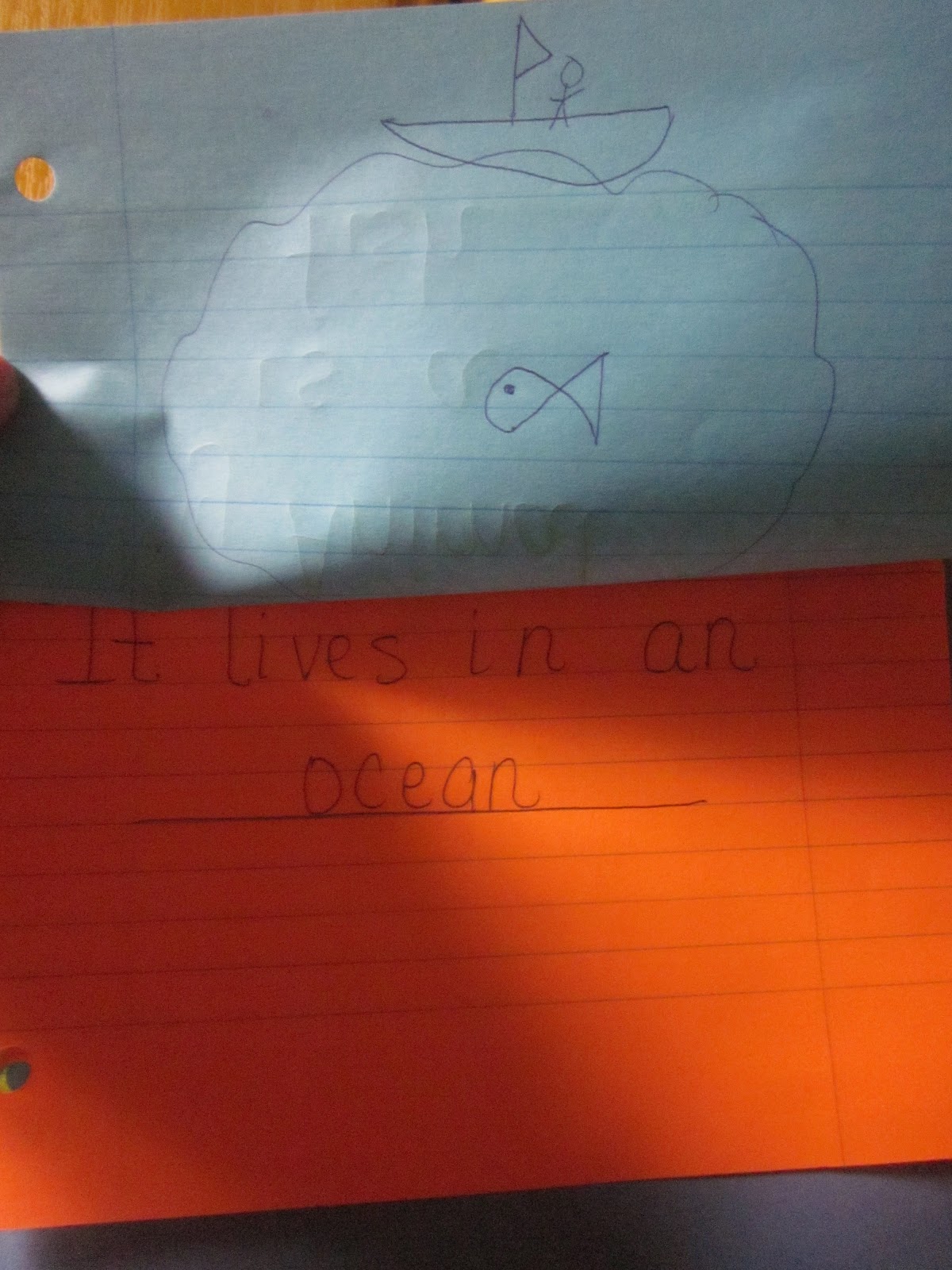 |
| Here is the writing book. The kids choose their animal, and then draw a picture at the top. |
 |
| Here is the next page. |
 |
| The following pages focus on cause and effect. We wrote 3 different things that our animal might try. |
 |
| I apologize that this one came out a little blurry. This booklet was our way of taking notes. Judith called it our HOTS book. To make this book we got 3 sheets of paper. We folded them hamburger style. We separated one of the sheets and made a one inch mark on either end. Then on the single page we shaved off just a tiny sliver in the center. On the other pages we cut from the end to our one inch mark. |
 |
| We put the book together by sliding the other pages through the slivered section. |
 |
| Here's another foldable that we made. We simple cut the top and divided it into two sections. You could use this for endless topics with comparing and contrasting. |
 |
| When you open it up you can write under the flap about the topic. |
 |
| Here was another one to the left on note taking about Management Strategies. On the right we used sticky notes to brainstorm how to differentiate. |
 |
| Another foldable using 2 sheets of paper. You write the topic outside and then explain more about it on the inside. |
 |
| This one was too cool! Once we cut it to look like above, we were told this would be our assessment. You could have the kids draw a diorama of the habitat. |
 |
| So to do this, you actually have to open up the above picture and draw your scene. Once it's completed, you can glue the ends so that it stands up. It was also suggested to make more than one habitat and glue them back to back displaying their scenery. |
 |
| Here is a simple hot dog paper folded into 5 sections. We cut the top flaps and then took notes about the workshop inside. |
 |
| Last, but certainly not least, we each received this awesome manual that has so many practical activities for K-2 all aligned with Common Core State Standards (they also have a 3-5 book, but this book can be adapted to use with 3-5 too)! |
Subscribe to:
Posts (Atom)